
Back to list
English
Head of Department: Judith Schutte
E: jschutte@bohuntfarnborough.com T: 01276 702540
Intent
Strong literacy is the key to success in all subjects, and indeed, all areas of life. We believe
that being able to read critically, write effectively, and speak confidently about a wide range
of topics are the most important skills that students should acquire – and we take that
responsibility as English teachers very seriously.
Key Stage 3
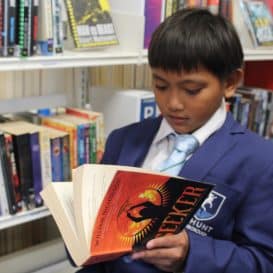
Reading, writing and oracy (being able to express yourself clearly) are taught and practised
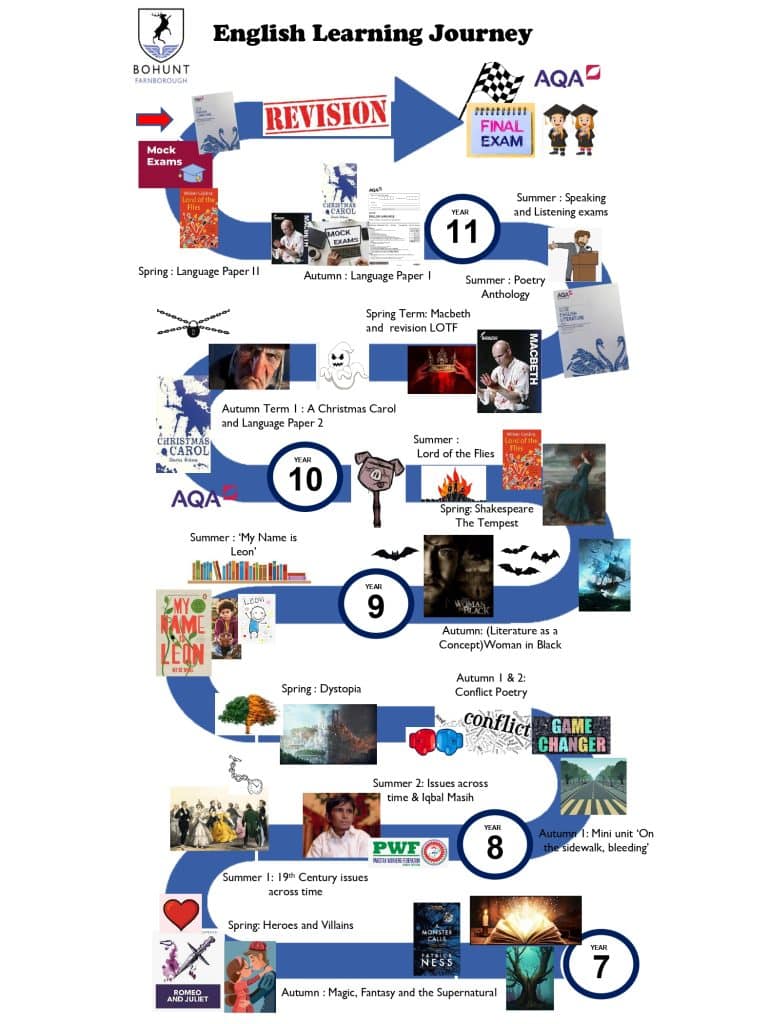
as part of each module. Our five-year curriculum map is designed so that in key stage 3,
students experience a broad range of texts, concepts and viewpoints, while developing the
skills needed for GCSE. All Y7 and Y8 students have a weekly ‘Reading Plus’ with the aim to
develop literacy.
Year 7
Year 7 is a showcase of the breadth of content we offer for English. We start in the Autumn
term with Magic, Fantasy and the Supernatural, with the focus on the novel, ‘A Monster
Calls’.
In Spring term, we focus on the life and times of William Shakespeare followed by a study of
his tragedy ‘Romeo and Juliet’. While reading the play, we also learn about features such as
dramatic irony and how actors use props and stage directions to create drama.
Finally, in Summer term, we start with ‘19 th Century issues across time’ and then the focus
shifts to the modern day, in our study of Inspirational People, starting with the story of
‘Iqbal’, a boy who liberated child labourers from the carpet factories of Pakistan.
Year 8
In Year 8 we build upon the skills practised in year 7, starting with a mini unit ‘On the
Sidewalk Bleeding’. We then explore a wide variety of poetry focussing on conflict,
designed to build their cultural capital by exposing students to poets from a wide range of
different nationalities and backgrounds. Students also have time to reflect on their own
cultural identity and what makes them who they are.
The topic in Spring term Dystopian Worlds where we delve into a plethora of dystopian
texts from 19th century writer HG Wells, to Orwell, to more modern writers. The themes
and writers' methods explored in this topic will strengthen their ability to grasp key ideas
and build on the skills they need for their GCSE texts.
In the Summer term, we move on to Kit de Waal's Novel, ‘My Name is Leon’ where we
explore ideas family and belonging, loss and grief, responsibility, identity and race, and
resilience.
Year 9
In Year 9, we increase the challenge as we begin to prepare for GCSE.
In the Autumn term we introduce Literature as a concept, staring with the novel ‘The
Woman in Black’ by Susan Hill. We then explore a range of extracts where students relish
the Gothic genre in preparation for ‘A Christmas Carol’ in year 10.
We start off in Spring Term with Shakespeare’s ‘The Tempest’, building the foundation for
understanding key themes but also an understanding for the wider context of the
Elizabethan era.
In the Summer term, we move on to ‘Lord of the Flies’ by William Golding – the first GCSE
English Literature text that we study. Our cold read approach helps students to solidify their
understanding of the plot and characters, before we move on to look at the key themes and
ideas. We chose this text because students relish the power struggles, but also there is a
wealth of wider contextual knowledge that acts as a hook to reel students back in when we
revise ahead of exams.
Key Stage 4
In English, we have two GCSEs that all students are entered for: GCSE English Language and
GCSE English Literature. Though students read one of their Literature texts in year 9, it is not
until year 10 that we really begin to focus on the assessment objectives and requirements of
the exam – enjoying and understanding the text must come first!
By the end of year 10, students have covered all of their Literature content (five sections)
and have practised the skills needed to be successful in Language. This means that year 11 is
for honing the knowledge and skills, perfecting exam techniques and practising specific
routines related to the four papers they will sit in the summer.
Year 10
In the Autumn term of year 10, we continue our Literature study with our second text, the
seasonal A Christmas Carol by Charles Dickens. As with our earlier novel studies, we use a
cold-read approach to allow students to immerse themselves in the storyline of the text
before we pull it to pieces and analyse it! In year 10, we start to interleave Language and
Literature. Alongside A Christmas Carol, students also study a range of 19th century non-
fiction extracts, allowing them to learn essential historic context, deepen their
understanding of the novel and practise their Language Paper 2 skills – all at once!
As we move into the Spring term, we cover our second GCSE
text: Shakespeare's Macbeth. Students’ earlier study of Shakespeare plays puts them in a
strong position to tackle this blood-spattered tragedy. We use a range of methods to help
students grasp the basics, before moving on to tackle the specifics of Shakespearean
language and broader background knowledge of Jacobean society.
Summer term kicks off with the Poetry Anthology, studying the fifteen poems in the power
and conflict cluster that students will need for the fourth section of their Literature exams.
As well as this, we complete the Spoken Language Endorsement. This is a mandatory part of
the English Language GCSE that requires students to present and then answer questions on
their chosen topic. Students are graded Pass, Merit or Distinction. While this can be a bit
nerve-wracking, it is a great opportunity for students to share their passions with their
teacher and peers, and also makes good practice ahead of the college interviews which soon
follow in year 11.
Year 11
Year 11 is about bringing it all together – filling any little gaps, approaching Literature texts
through more mature lenses, and building confidence ahead of the exams in the Summer.
We continue the interleaved approach – revising Language and Literature alternate weeks –
to help students prepare for the demands of final revision and the mental (and emotional)
challenge of the exam period.
Modern Foreign Languages
Head of Department: Lisa Loch
E: lloch@bohuntfarnborough.com T: 01276 702540
Curriculum Profile
Our Mission
The MFL Curriculum provides students with the knowledge, skills, values and attitudes to navigate the world successfully and become the next generation of game-changers.**
Developing Game-Changing Linguists
Our students will:
– Use knowledge and strategies effectively to understand and manipulate language in a range of contexts
– Adapt language to communicate and exchange information, thoughts and ideas confidently
– Show cultural awareness and curiosity, and actively seek to learn about the world around them
Knowledge
Our curriculum provides students with opportunities to:
– Gain systematic knowledge of vocabulary, grammar, and phonics
– Have this knowledge explicitly taught and consolidated through extensive practice
– Reinforce learning across all four language skills (listening, speaking, reading, writing)
– Revisit knowledge in a range of contexts
– Commit this knowledge to long-term memory
– Articulate their understanding clearly
Skills
We empower students with the tools to:
– Develop receptive and productive skills equally
– Understand and manipulate language in a range of contexts
– Adapt language and communicate their own ideas effectively and confidently
– Use language with flexibility and creativity
– Reflect and act on mistakes to develop their skills further
– Exchange information and communicate with purpose
Values
We encourage students to:
– Enjoy and make the most of learning and enrichment opportunities available to them
– Draw comparisons between languages and cultures
– Show respect and empathy for other cultures
– Make good use of tools and resources available to progress
– Perform to the best of their ability
– Appreciate cultural similarities and differences
Attitudes
We inspire students to:
– Show cultural curiosity and seek to find out more about target language countries
– Show resilience when presented with more challenging language
– Develop their independence and take risks to tackle challenges
– Actively seek to learn about the world around them
– Embrace new learning opportunities with confidence
Our Teaching Approach
Literacy & Oracy
– Vocabulary identified and pre-loaded before lessons
– Call and response practice for challenging vocabulary
– Teacher reads aloud and models reading strategies
– Teacher thinks aloud when reading texts and modelling tasks
– Challenging and culture-rich texts used throughout
Cultural Enrichment
– Links with other countries and cultures discussed (similarities and differences)
– Culture passport used to encourage students to learn about target language countries
– MFL in the News Padlet used to expose students to authentic resources
– Game-changer activities used to inspire students and promote culture
What Will My Child Study?
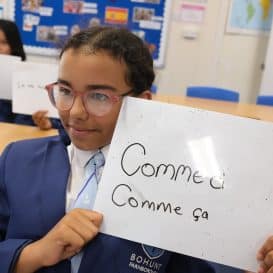
All students study either French or Spanish from Year 7, following the same curriculum structure in both languages. In Year 7, students build foundations by learning to introduce themselves and others, describe their family, discuss their daily routines, and talk about their school life and free time activities. They develop key grammar skills including present tense verbs and question formation. In Year 8, students expand their language skills to discuss where they live, describe their town and local area, talk about food and restaurants, plan future holidays, and explore cultural celebrations and festivals. They begin to use past and future tenses alongside more complex present tense structures.
At the end of Year 8, students choose whether to continue with their language at GCSE level. In Year 9, those who opt for GCSE study deepen their knowledge across key themes including relationships, leisure activities, sports and health, environmental issues, and their personal world of school, careers, and aspirations. In Years 10 and 11, students follow the GCSE curriculum covering four main themes: Identity and Culture (including family, technology, and free time), Local and Global Areas of Interest (including home, social issues, and global concerns), Current and Future Study and Employment, and Travel and the Wider World.
Throughout, students develop all four language skills—listening, speaking, reading, and writing—preparing them thoroughly for their GCSE examinations through regular practice of exam-style questions, role-plays, photo cards, and past papers.
Our MFL curriculum equips every student to become a confident, curious, and culturally aware linguist ready to navigate an interconnected world.