
Back to list
Physical Education
Head of Department: Mark Potter
E: mpotter@bohuntfarnborough.com T: 01276 702540
Intent
Our intent for PE at Bohunt Farnborough is simple; it is to inspire and engage physical, social and mental appreciation of body movement and sporting skills which builds upon and leads to lifelong involvement in physical activity.
We do this with key themes for each group pupils take part in sport:
Our acronym of ACTIVE is how we instill this life long passion for physical activity within our pupils.
ACTIVE:
We hope to see the impact of what we do in the following areas:
KS3 Core PE
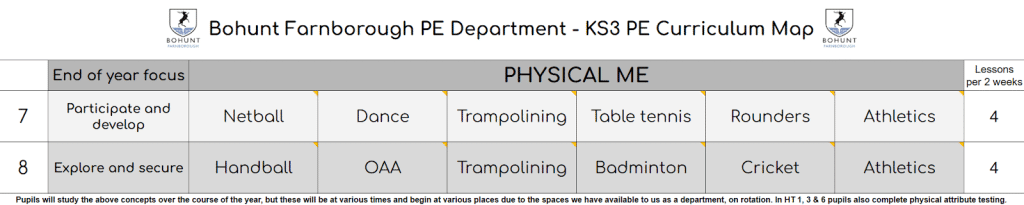
At key stage 3 (years 7 and 8) pupils have 4 lessons of PE over the 2 week time table.
Lessons are a mix of teacher and pupil led and are assessed against the MEs in PE at Bohunt Farnborough. Our assessment strands for KS3 core PE are:
Physical ME (focuses on skills, techniques, tactics and fitness)
Social ME (focuses on leadership, teamwork, communication and personal organisation)
Thinking ME (focuses on evaluating, analysing and creativity)
Competitive ME (focuses on rules, regulations, scoring and officiating)
Pupils take part in 12 activities over the 2 years which enables them to have a wide range of experiences and at the same time spend enough time on each to make the physical, social and mental progress they need to.
The facilities used are as follows:
Sports hall
Main hall
Old Gym
Courts
Field
This is our KS3 overview below.
KS4 Core PE
At key stage 4 (years 9, 10 and 11) pupils have 2 lessons of PE over the 2 week time table. This is an area of development for the department.
Lessons are a mix of teacher and pupil led and are assessed against the AtL criteria set out by the school.
Pupils take part in 12 activities over the 2 years in year 9 and 10 which enables them to have a wide range of experiences and at the same time spend enough time on each to make the physical, social and mental progress they need to. They then are assigned various spaces in year 11 to which pupils chose, along with teacher input, the activities they wish to participate in. This sustain and maintain element is key to allowing pupils the choice they need and deserve, being able to utilise the skills they have gained lower down the school.
The facilities used are as follows:
Sports hall
Main hall
Old Gym
Courts
Field
This is our KS4 overview below.
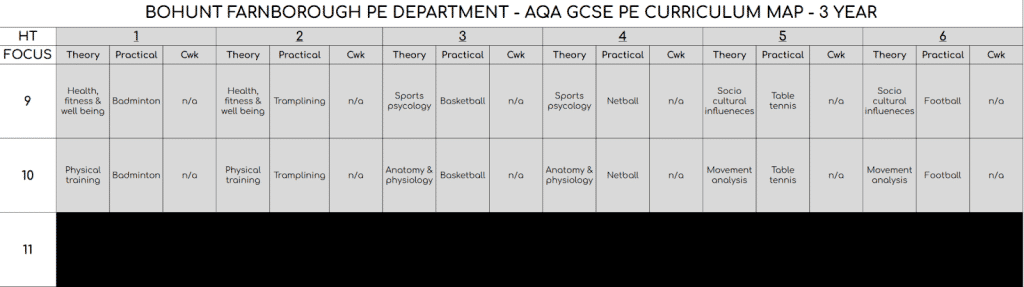
AQA GCSE PE
At key stage 4 (years 9, 10 and 11) pupils have 5 lessons of GCSE PE over the 2 week time table.
Lessons are a mix of theory and practical in year 9 and 10 (3 year course) and are all theory based in year 11 (2 year course). Practical is taught in Core PE for GCSE PE in year 11.
This is our KS4 overview below.
2 year (Year 11 only):
3 year (Year 9 and 10 only):
GCSE PE Theory (60%)
Within theory lessons there are a number of topic areas which are covered in preparation for a theory exam at the end of the 2 year course, in the format of two written exam papers, lasting 1 hour 15 minutes each.
Theory topic areas: Anatomy and Physiology, Movement Analysis, Physical Training, Sports Psychology, Socio-cultural Influences, Health Fitness and Well-being and the use of data.
Within the lessons, the students will be taught the specific course content across the 6 units. But more importantly, how to apply that knowledge to sporting examples and real life situation. This is the most vital part of the course, as this is how the students will pick up the higher marks in the exams.
GCSE PE Practical (30%)
The practical lessons focus on refining and improving skills, knowledge and understanding in a variety of different sporting activities. Finally we assess the students in 3 activities; one of which is an Individual Activity, one that is a Team Activity and finally the third being an Individual or Team Activity.
For those students that participate in a sport outside of school, but we are unlikely to cover the sport in school (Skiing, Squash, Boxing), they can still be assessed in that sport if it is on the AQA specification.
GCSE PE Coursework (10%)
Written piece of Coursework: Analysis and Evaluation. This is where the student selects an activity that they compete in and analyse their performance, highlighting their strengths and weaknesses. Then put together a plan of how they would develop and improve their weaknesses.
Demonstrating their ability to analyse their own performance as well as being able to draw on some of the subject knowledge they have been taught, to apply that to a real life situation of trying to improve their own performance.
For the academic year 2026/2027 this exam course is under review for the department and may change.