
Back to list
Science
Head of Department: Molly Gregory
E: mgregory@bohuntfarnborough.com T: 01276 702540
Intent
Key Stage 3
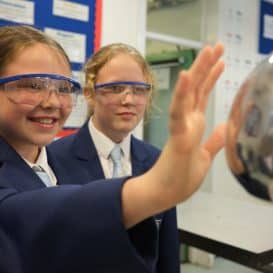
Our KS3 Science curriculum aims to captivate students’ love of the subject whilst also giving them the opportunity to experience new experiments in our labs.
At Bohunt Farnborough KS3 Science encompasses Years 7 and 8 and students are taught all three disciplines throughout.
Within the Biology topics students explore tiny cells under a microscope, the parts of a flower through dissection and plan investigations to see how unique we all are.
Chemistry involves understanding the link between tiny atoms and the Earth itself. Practicals take centre stage with students looking at separating techniques, group 1 elements, the colourful acids and alkalis and combustion.
For Physics students study big challenging concepts including energy and electricity with the hope to therefore understand the world around them. They also have the opportunity to study the interesting topics of sounds and light and electromagnet.
At the end of KS3 students will be ready to take the next step in their Science careers at Bohunt Farnborough and will be fully prepared to start their GCSE journey.
Key Stage 4
The GCSE Trilogy Combined Science course at Bohunt Farnborough includes Biology, Chemistry and Physics and involves two exams for each discipline at the end of Year 11. Students will be awarded two GCSEs grades which will enable them to study any of the Sciences at A level with a grade 6-6 or above.
Biology
1.Cell biology
2.Organisation
3.Infection and response
4.Bioenergetics
5.Homeostasis and response
6.Inheritance, variation and evolution
7.Ecology
Chemistry
1.Atomic structure and the periodic table
2.Bonding, structure, and the properties of matter
3.Quantitative chemistry
4.Chemical changes
5.Energy changes
6.The rate and extent of chemical change
7.Organic chemistry
8.Chemical analysis
9.Chemistry of the atmosphere
10.Using resources
Physics
1.Energy
2.Electricity
3.Particle model of matter
4.Atomic structure
5.Forces
6.Waves
7.Magnetism and electromagnetism
Further details about what each topic involves can be found on the curriculum maps.
Within these topics students are required to conduct 21 required practicals which are assessed within the exam. In addition, lessons will also involve other practicals to support learning throughout.
Please see the curriculum maps for a more in-depth explanation for each year group.
Year 7
All year 7 students will start with the basics of science, that being cells, particles and energy. From these critical areas we venture in topics such as reproduction, electricity, acids and chemical reactions. We focus on getting the students’ confidence in these building blocks of science so the rest of their curriculum is a smooth progression into more complex areas.
Year 8
Year 8 students start to learn about more difficult chemical reactions, including how to write these reactions down using chemical notation. Light, sound, digestion and forces are also fleshed out in this year.
Year 9
The first year of GCSE Science is composed of the following topic areas. Chemistry; structure of atoms, maths of chemistry, how atoms bond with each other and the energy in chemical reactions.
Biology; cells, causes of disease and immunity, systems within the human body and how they functions, how plants use sunlight to live and how we power our muscles.
Required practicals including microscope, separating techniques and electrolysis are also covered.
Key Stage 4
Year 10
The second year of GCSE Science is composed of the following topic areas.
Chemistry; how different atoms bond together and the repeatable rules that govern these reactions.
Biology; how genetic information is transferred from one generation to the next and the rules that govern this, how different members of the same species are different and how this drives evolution, how the human body controls various systems to insure there normal functioning
Physics; how is energy measured, what is it and how it is transferred from one system to another, how electricity is used, measured and calculated, how solids, liquids and gases change from one state to another and how radioactivity is measured and used.
Required practicals include a wide range o f circuit board practicals.
Year 11
The third year of GCSE Science is composed of the following topic areas.
Chemistry; how chemical reactions can be slow or fast and how to measure these, a close look at a specific group of chemicals known as hydrocarbons, how the Earth’s atmosphere has changed over time and how the resources humans use can be modified to make them more sustainable.
Biology; how Planet Earth’s ecosphere functions and how the fragile systems work together to sustain life. The effect of humans on this ecosphere will also be studied.
Physics; How forces on objects can be categorised and measured, the different laws of Newton and how speed can be measured in various ways. Summarising the different types of waves, how they are measured and their different functions, How magnetism works and how different types of magnets work.
Required practicals including measuring the rate of specific chemical reactions and measuring acceleration.